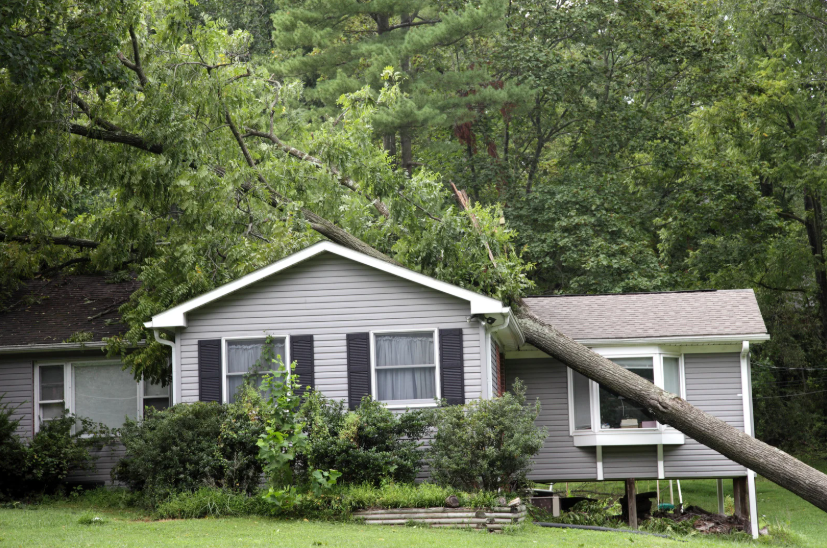
A heavy limb cracking in the middle of the night. A tree down across the driveway after a wind event. Property owners across Sonoma County know the sound, and the sinking feeling that follows.
The first hour after a tree comes down shapes everything that happens next: how safe your household stays, how your insurance claim goes, and how quickly your property returns to normal.
This guide walks you through that first hour so you can act with a clear head. You’ll know who to call, in what order, and when emergency tree removal in Sonoma County, CA has to happen right away.
Key Takeaways
- People first: check everyone in the household for injuries before touching anything, and clear the house if the tree compromised the structure.
- Treat every downed line as live. Stay back at least 35 feet and keep pets and neighbors clear.
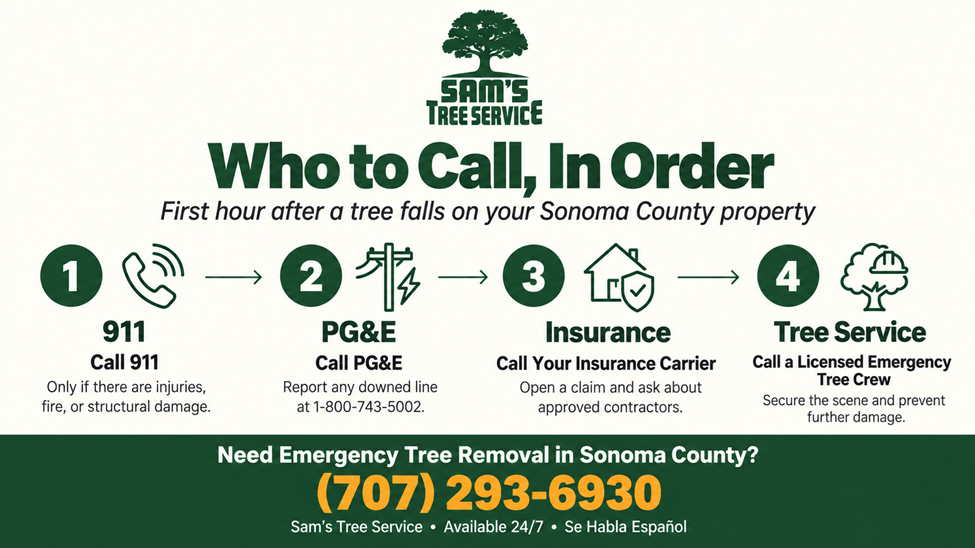
- Call in a specific order: 911, PG&E, your insurance carrier, then a licensed emergency tree crew.
- Document the scene with photos and video before anything moves. Those files protect your claim.
- A fallen tree is loaded with pressure. A licensed, insured, and bonded crew keeps the second accident from happening.
Before You Do Anything, Pause for 60 Seconds
It’s natural to want to rush out and start cleaning up. Slow down for a minute first. Take a full minute to look and listen before you move toward the tree. Check:
- Which way the tree fell
- Whether the tree hit the house or building
- Whether you can see fallen utility lines
If the tree is still shifting, groaning, or dropping limbs, it isn’t done moving. Give it time and space.
Step 1: Check Everyone for Injuries
Count heads. Make sure every person and pet is accounted for.
When to Call 911 Immediately
Get everyone outside and call 911 right away if:
- Someone is hurt or trapped
- A tree has broken through a roof, wall, or window above an occupied room
- You smell gas or hear hissing near the structure
- There’s any sign of fire or sparking
Firefighters and paramedics have the tools and training for extractions and structural hazards. A tree collapse can also damage gas lines in the attic or crawlspace, which is another reason to clear the house when any part of the structure took a direct hit.
Watch for Delayed Symptoms
Even if nobody is visibly injured, keep an eye out in the hour that follows for:
- Headaches
- Dizziness
- Chest pain or shortness of breath
Adrenaline hides a lot in the first few minutes.
Step 2: Stay Far Away from Downed Power Lines
If the tree took a line down with it, your entire property perimeter changes. A line on the ground can energize:
- Fences
- Puddles
- Wet grass
- Parked cars
- The tree itself
You cannot tell by looking whether a line is live.
- Stay back at least 35 feet from any downed line or anything the line is touching.
- Keep children and pets inside.
- Warn arriving neighbors to do the same.
Do not drive over a downed line, because tires are not reliable insulation and leaving the car becomes extremely dangerous.
Warning ⚠️: Never try to move a tree, branch, or limb that is touching a power line, transformer, or service drop to the house. That job belongs to PG&E and a certified tree crew, in that order.
Step 3: Work Through the Call List: 911, PG&E, Insurance, Tree Crew
Order matters here. Each call does something the next one depends on.
- Only when there are injuries, a structural breach, suspected gas leak, or active fire. The dispatcher will route the right responders and can relay to PG&E.
- PG&E. Report any downed line, leaning pole, or sparking line at 1-800-743-5002 (the 24-hour emergency line). PG&E has to de-energize and secure the area before any tree work can begin near the lines.
- Your insurance carrier. Open a claim as soon as the property is safe. Ask about covered services, approved contractors, and whether emergency tree removal reimbursement needs pre-authorization.
- A licensed emergency tree service. Once the scene is secured, a professional crew can begin safe removal, tarp the roof, and keep debris off neighboring properties.
Keep every reference number from every call. Insurance adjusters ask for them.
Step 4: Document Everything Before Anything Moves
Photos and video from the first hour carry more weight than any later estimate. Walk the perimeter at a safe distance and capture:
- Wide shots that show the tree’s full position
- Close-ups of damage to the roof, siding, fence, vehicles, or landscaping
- Any downed lines (zoomed in, from a distance)
- The base of the tree and the soil around it, which can show whether it uprooted or snapped
- Timestamps and dates on the files
If you have a drone, or a second-story window with a clear view, overhead photos help the adjuster see what a ground shot cannot. Save the originals and send copies to the carrier.
Step 5: Call a Licensed Tree Crew Right Away
In Sonoma County, a tarp and a wait-and-see approach rarely holds up. Fall and winter rains follow the wind events that bring trees down, and a compromised roof or exposed wall gets worse by the hour.
A licensed emergency tree removal crew in Sonoma County, CA can typically get a plan in motion within hours of your call.
A trained crew will:
- Assess load, tension, and lean before any cut is made
- Coordinate with PG&E if lines are still a factor
- Secure the roof with proper tarps rated for wind and rain
- Keep debris off neighboring properties, shared driveways, and fence lines
- Haul the material or chip it on site, depending on your preference
Why Homeowners Call Sam’s Tree Service
The Sam’s Tree Service team has handled fallen trees across Santa Rosa, Petaluma, Windsor, and the rest of Sonoma County since 2019, backed by Sam Senior’s 30 plus years in the industry.
The crew is:
- Fully licensed, insured, and bonded
- Cal OSHA certified for power line trimming
- Overseen by a qualified arborist
- Bilingual (se habla español)
Property owners have described the Sam’s Tree Service crew as “professional, efficient, thoughtful and respectful of the property,” noting how clearly the team communicates throughout the job.
That communication is even more valuable when a tree is down and the clock is running.
Call Sam’s Tree Service for Emergency Tree Removal in Sonoma County
When a tree comes down, you want a local crew that answers the phone, shows up with the right equipment, and keeps your household and your neighbors in the loop.
Sam’s Tree Service provides emergency tree removal in Sonoma County, CA for homeowners and property owners in Santa Rosa, Petaluma, Windsor, and the surrounding communities.
Contact us online or call Sam’s Tree Service at (707) 293-6930.
Frequently Asked Questions

Owner / Operator, Sam’s Tree Service
Sam Garcia, owner of Sam’s Tree Service, founded his company in 2019. However, the roots of the business go much further back to Sam Senior.
With over 30 years in the tree business, Sam Senior was employed with a large well-known tree company where he gained deep experience working with a power line contractor.
Today, Sam’s Tree Service is a father-son business with full family involvement that combines family values and local commitment with friendly customer service.
With a qualified arborist to oversee the work, customers count on Sam’s for broad expertise with trees, from trimming and pruning to removal, emergency tree services and more. In addition, both Sam Senior and Junior have power line experience, which is essential for any tree work that is in or immediately adjacent to power lines.


