Most Sonoma County property owners hit a moment where a tree on their property has changed, and they’re not sure what to do about it.
The right answer depends on the season, the species, the tree’s condition, and how close it sits to power lines, houses, or the neighbor’s fence.
This guide walks through when to remove a tree, when it can wait, and what the whole process looks like from the first estimate to the last pile of chips. Sonoma County tree removal has real rules and risks behind it and knowing them ahead of time saves money and prevents surprises during the process.
Key Takeaways
- The best time to remove most trees around Sonoma County is late winter or early spring while they’re dormant. Hazard trees and storm damage don’t wait for a season.
- Removal isn’t always the answer. Plenty of trees can be saved with the right pruning if the problem gets caught early.
- Some tree removals need a permit, especially for protected species, heritage trees, or work inside certain city limits. A quick call to the local planning department clears it up.
- Any tree work within 10 feet of a power line is a Cal OSHA regulated job. Homeowners should never take this on themselves.
- Wood from a removed tree still has value. Chips make good mulch, and larger rounds often turn into great firewood once they’ve had time to season.
Why Timing Matters for Tree Removal
A tree taken down at the wrong time of year can stress nearby plants, spread disease, or cost more because of weather delays. A tree left standing too long can end up on a roof, a fence, or a power line during the next big wind.
Three things shape removal timing in Sonoma County:
- Winter storms
- Fire season
- The dormancy cycle of common local species like oaks, redwoods, and eucalyptus
Working with the calendar instead of against it gets you better results and lower risk.
The Best Times of Year to Remove a Tree
Late Winter to Early Spring: The Dormant Season
For most deciduous trees, and a lot of evergreens too, the dormant season is the sweet spot for removal. Around Sonoma County, that’s roughly late December through early March.
A few reasons why:
- Sap flow is low, so open cuts are less likely to invite disease.
- The leaves are down on many species, which means crews can see the structure clearly.
- Surrounding plants are dormant too, so root disturbance from equipment does less damage.
- The ground is often firmer than during the wettest weeks of spring.
Oak wilt and other fungal problems are less active in cold weather, which makes winter the safer time to cut oaks specifically. It’s also a good window to address overgrowth on the property before spring growth kicks in.
Late Spring to Early Summer: Before Fire Season
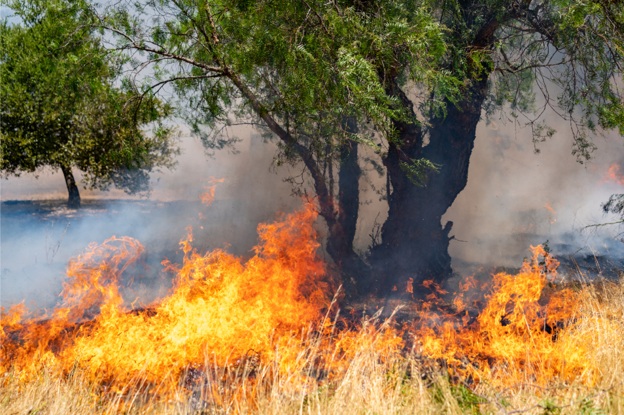
Fire season usually ramps up in June and stretches into October. Removing a hazardous tree, especially one near the house, driveway, or a power line, is best done before fire season arrives.
Why this window works:
- Dead or dying trees are fuel. Getting them out early reduces ignition risk.
- Access matters during a fire. Overgrown trees along a driveway can slow down emergency vehicles.
- Insurance carriers in Sonoma County have gotten stricter about defensible space. Some require removal of specific trees within 30 to 100 feet of the house.
If your property sits in a Cal Fire State Responsibility Area or a Local Responsibility Area rated very high for fire hazard, defensible space rules apply. Removing dead trees within Zone 0 (0 to 5 feet) and Zone 1 (5 to 30 feet) around the house isn’t optional.
After a Storm: Reactive Removal
Winter storms bring wind, soaked soil, and sudden failures. A tree that looked fine in October can uproot in February. Post-storm removals follow a different playbook than planned ones.
If a storm-damaged tree is:
- Down across a driveway, road, or roof: call a professional right away.
- Leaning against another tree or a structure: leave it alone and call. These “hangers” are unpredictable and dangerous.
- Split at the trunk but still standing: treat it as an emergency. It’s likely to fail again.
- On or near a power line: call PG&E first, then a tree company. Don’t go near it.
If you see the soil bulging on one side of the trunk, or roots showing that weren’t showing before, the tree is likely compromised even if it still looks upright.
Summer Removals: Timing and Tradeoffs
Removing trees in July and August isn’t off the table, but there are tradeoffs. Heat stress on surrounding plants runs higher. Fire safety protocols can limit certain equipment on red flag days. Crews are usually at their busiest, too.
That said, real hazards don’t wait for a better month. A hollow limb hanging over a bedroom in August should come down in August.
When a Tree Can’t Wait: Emergency Removal Signs
Some situations skip the calendar entirely. If any of these show up, call a tree service the same day:
- A new lean that showed up after a storm or over a short window, especially with cracking sounds or soil movement at the base.
- Big dead limbs hanging over living areas, walkways, driveways, or vehicles.
- Cracks running vertically down the trunk, or horizontal cracks in a major limb.
- Fungal growth at the base, especially big brackets or shelf fungi. These usually mean internal decay.
- Root damage from recent construction, trenching, or grading anywhere inside the drip line.
- Any contact with a power line, even a light branch touch. That’s a safety emergency and a regulated one.
A same-day call doesn’t always mean same-day cutting. Good crews will stabilize the situation, tape off the area, and schedule the work for the safest window.
Removal vs. Pruning: How to Tell the Difference
Not every troubled tree needs to come down. Homeowners often jump to the worst case when a professional would suggest targeted pruning instead. Knowing the difference protects the landscape and the budget.
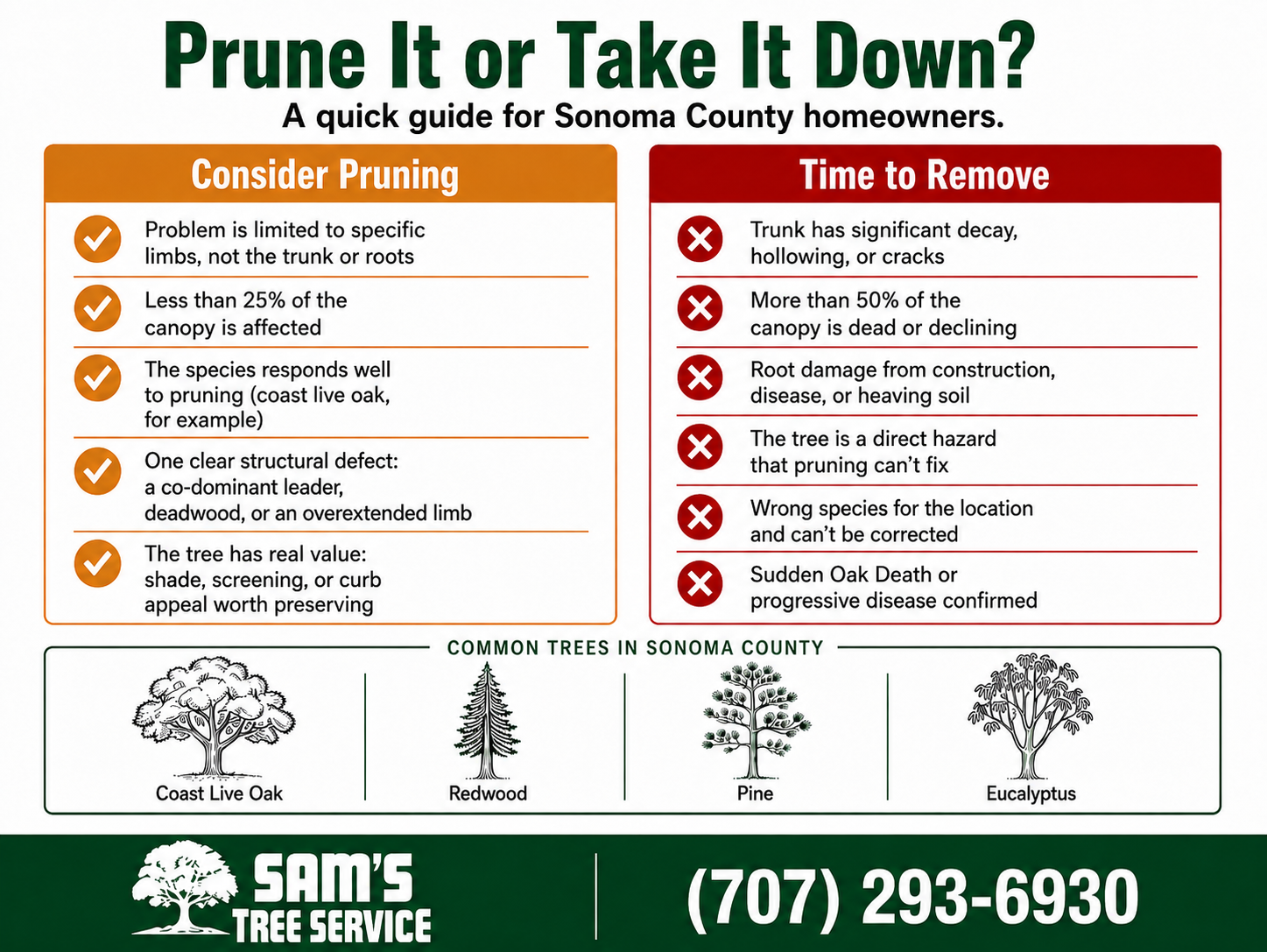
When Pruning is Typically Enough
- The issue is on specific limbs, not the trunk or root system.
- The tree has one clear defect (a co-dominant leader, a heavy overextended limb, deadwood in the crown) rather than a general decline.
- Less than 25% of the canopy is affected.
- The species heals well from cuts. Coast live oaks, for example, respond well to skilled pruning.
- The tree has real value on the property: shade, screening, wildlife habitat, or curb appeal worth preserving.
When Removal is the Right Call
- The trunk has significant decay, hollowing, or cracks that hurt structural integrity.
- More than half the canopy is dead or declining.
- Root damage is extensive, whether from construction, disease, or heaving soil.
- The tree is the wrong species for its spot and can’t be corrected. A redwood 6 feet from a foundation is a classic example.
- The tree is a direct hazard that pruning can’t fix.
- Sudden Oak Death or another progressive disease has already taken hold.
A natural lean isn’t automatically a hazard. Many trees grow at an angle because of light, wind, or slope and are perfectly stable. What matters is whether the lean is new and whether the soil or root plate shows signs of movement.
An arborist assessment costs less than an unnecessary removal. When there’s any doubt, get eyes on the tree before committing to take it down.
Sonoma County Tree Removal Permits: What Homeowners Should Know
Permit rules for tree removal can vary. Local ordinances have tightened over the past decade, especially for heritage and native species.
General categories of protection
Different jurisdictions in Sonoma County use variations of these categories. Rules change, so always double-check with the local planning department before work starts.
- Heritage or landmark trees. Trees of a certain size, age, or historical value are often protected in incorporated cities. Removal usually needs a permit and sometimes a public review.
- Native oaks. Coast live oak, valley oak, and black oak are commonly protected, especially at larger trunk diameters. Sonoma County and several of its cities have specific oak preservation ordinances.
- Riparian trees. Trees along creeks, streams, and other waterways often fall under separate rules for habitat and erosion reasons.
- Trees on properties with active permits. If there’s an open building permit on the property, removal may be tied to the project approval.
- Trees in the public right-of-way. Street trees and trees on public land almost always have their own rules.
When Permits Typically Aren’t Required
Most jurisdictions allow removal without a permit when:
- The tree is dead, dying, or an imminent hazard, documented by an arborist.
- The tree is a common non-protected species below a certain size.
- The tree sits on private residential property outside a special zone.
Before any Sonoma County tree removal, call the planning or building department for the specific city or unincorporated area the property sits in. A 10-minute phone call can save thousands in fines.
A good tree service team should be able to determine whether a permit is likely needed and can provide the arborist documentation that many permit applications ask for.
What to Expect from the Tree Removal Process
Most homeowners have never watched a big tree come down. The process is more organized than it looks from the sidewalk, and knowing what happens step by step takes a lot of the stress out of the day.
Step 1: The Estimate and Walk Through
A professional starts with an on-site look. That means:
- Identifying the species and checking the tree’s condition.
- Measuring trunk diameter, crown spread, and height.
- Checking clearances: power lines, buildings, fences, gardens, property lines.
- Looking at access for equipment and the crew.
- Talking through what happens to the wood and debris.
A written estimate should spell out the scope, the cleanup plan, and any conditions, like permit requirements or utility coordination.
Step 2: Preparation and Utility Coordination
Before the crew rolls up, a few things need to happen:
- Permits (if needed) are confirmed.
- If the tree is near power lines, coordination with PG&E may be needed for a temporary line drop or clearance approval.
- The homeowner clears the work zone: cars moved, patio furniture out of the way, gates unlocked for equipment access.
- Neighbors get a heads up when work will affect noise, driveway access, or the property line.
Step 3: The Removal
Method depends on where the tree is and what shape it’s in:
- Felling: Cutting the tree so it drops in one piece. Only used when there’s a safe, clear drop zone.
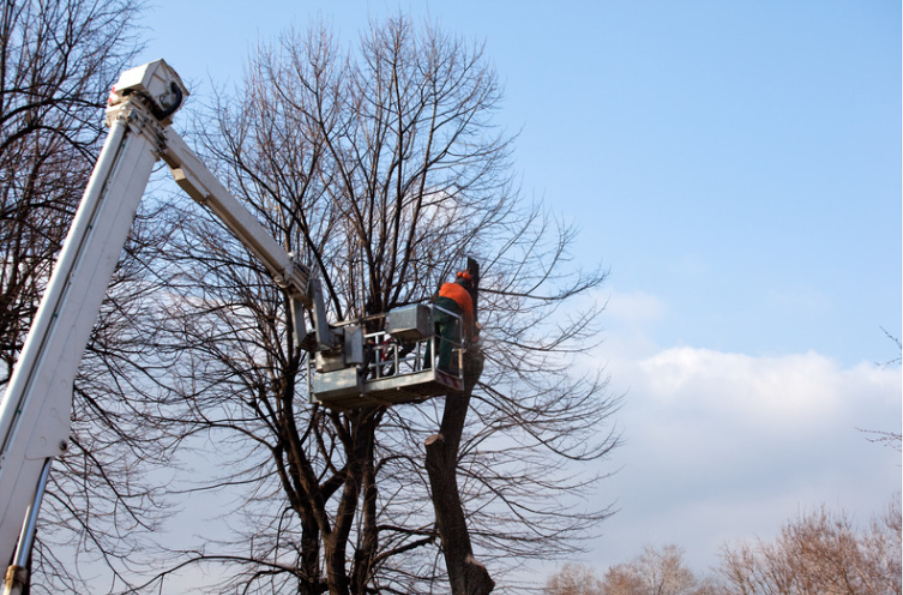
- Sectional dismantling: Climbing the tree or using an aerial lift to cut and lower pieces one at a time. Standard for most yards.
- Crane-assisted removal: For very large trees, hazard trees, or tight sites. A crane lifts sections out cleanly.
Rigging, ground crew communication, and drop-zone control are what separate a safe removal from a dangerous one.
Step 4: Stump Handling
Stumps have three common outcomes:
- Left in place, cut low. Cheapest option, but the stump stays and may sprout back.
- Ground down, usually 6 to 12 inches below grade, which allows replanting or grass over the area.
- Fully removed, roots and all. This is the most invasive and expensive option and is usually done when something is going in on top, like a patio or a foundation.
Stump grinding is often quoted separately from removal. A full-service removal typically includes chipping branches on site, hauling or leaving the wood, and cleaning up driveways and walkways. Ask upfront so nothing comes as a surprise.
What to Do with the Wood After Removal
A large tree produces a surprising amount of material. Two common uses keep it out of the landfill and put it to work right on the property.
Wood Chips
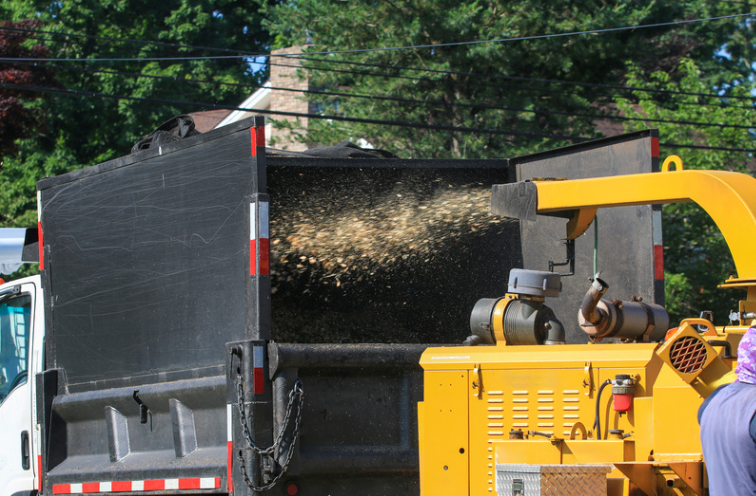
Chipped brush and small branches make good landscape mulch.. A few benefits:
- Cutting down on weeds in beds and around trees.
- Holding soil moisture, which matters in a Sonoma County summer.
- Slowly adding organic matter as the chips break down.
- Reducing the need for store-bought mulch.
If there’s room on the property, ask the crew to leave the chips in a pile. Fresh chips should sit for a few weeks before getting spread thickly around plants, since they can pull nitrogen from the soil while they decompose. A 2 to 3 inch layer works well for most landscape uses.
Firewood
Trunk sections and larger limbs often make excellent firewood.
Freshly cut rounds are too wet to burn well and need time to season. Plan on 6 to 12 months for softer species and 12 to 24 months for oak, split and stacked in a covered spot with good airflow.
Avoid stacking big piles of firewood within 30 feet of the house, especially during fire season. Defensible space rules discourage it for good reason.
Tree Removal Near Power Lines: A Specialized Job
Any tree work within 10 feet of an energized power line is regulated by Cal OSHA and the California Public Utilities Commission. Specific certification is required to keep everyone safe.
What Homeowners Should Never Do
- Prune, cut, or try to remove any tree touching or within 10 feet of a power line.
- Use ladders, poles, or long tools near overhead lines.
- Assume a line is “just a phone line” or “probably not live.” Treat every overhead wire as dangerous.
- Hire a general tree service without confirming they have qualified line clearance tree trimmers on the crew.
What Qualified Crews Do Differently
Cal OSHA certified line clearance work takes specific training in:
- Electrical hazards
- Minimum approach distances
- Rigging techniques that keep workers, equipment, and the tree away from live lines
Certified crews also know how to coordinate with PG&E for line drops or de-energization when the tree is too close for a standard clearance.
Sam’s Tree Service has Cal OSHA certification for power line trimming and removal, with direct hands-on experience working alongside a power line contractor. Line clearance work is one of the most dangerous jobs in the industry, and that background makes a real difference.
How to Choose the Right Tree Removal Company
A short checklist for sizing up a tree service around Sonoma County:
- Licensed as a California contractor (C-61/D-49 Tree Service Contractor classification).
- Insured with general liability and workers’ compensation. Ask to see current certificates.
- Bonded, which adds another layer of financial protection.
- Cal OSHA certified for line clearance work, if the tree is anywhere near a power line.
- Arborist-guided, with a qualified arborist involved in assessments and the more complex removals.
- Locally referenced. Ask for recent Sonoma County customers or check reviews from properties near yours.
- Clear on scope and cleanup, with a written estimate that says exactly what’s included.
- Bilingual capability, if that helps your household or your neighbors during coordination.
Low bids that skip insurance or certification aren’t really a bargain. If a crew gets hurt on an uninsured job on your property, the liability can end up on you.
Questions About a Tree on Your Property? Get a Free Estimate
Sam’s Tree Service has helped homeowners across Sonoma and Marin Counties, handling everything from single-tree removals to full defensible space clearing.
The team is fully licensed, insured, bonded, and Cal OSHA certified for power line work, with a qualified arborist involved in every complex job.
If a tree on your property has you second-guessing whether it’s safe, or you’re planning ahead for dormant season or pre-fire season, an on-site look is a good first step. Contact us online or call Sam’s Tree Service at (707) 293-6930 to schedule a free estimate.
Frequently Asked Questions

Owner / Operator, Sam’s Tree Service
Sam Garcia, owner of Sam’s Tree Service, founded his company in 2019. However, the roots of the business go much further back to Sam Senior.
With over 30 years in the tree business, Sam Senior was employed with a large well-known tree company where he gained deep experience working with a power line contractor.
Today, Sam’s Tree Service is a father-son business with full family involvement that combines family values and local commitment with friendly customer service.
With a qualified arborist to oversee the work, customers count on Sam’s for broad expertise with trees, from trimming and pruning to removal, emergency tree services and more. In addition, both Sam Senior and Junior have power line experience, which is essential for any tree work that is in or immediately adjacent to power lines.