Most big tree bills have a story behind them. A split limb that nobody got up close to for a couple of years. A lean somebody meant to ask about and never did. A dead branch over the driveway that finally gave way in a January storm. By the time the crane shows up, the job has turned urgent, complicated, and expensive.
There is a quieter way to own trees in Sonoma County, and it comes down to three habits: pruning on a schedule, inspecting each year, and insisting on qualified hands at every step.
Those three habits are what make routine care the most affordable tree service in Petaluma a homeowner can plan for, because the cheapest visit is the one you never need in the first place.
Key Takeaways
- Tree bills are usually small when work is scheduled and large when work is forced.
- Routine pruning and an annual inspection catch the problems that turn into emergencies.
- Waiting rarely saves money, because risk, size, and complexity keep growing.
- Credentials matter at every point, from the first inspection to the last cut.
- Sam’s Tree Service builds its approach around preventing the expensive call, not waiting for it.
The Hidden Cost of Reactive Tree Care
Most tree care in Petaluma gets booked for one of two reasons:
- Something fell.
- Something looks like it’s about to.
Both are reactive. Both are the most expensive version of the same job.
When the work is forced, the costs stack:
- Emergency crews and overtime hours
- Specialty equipment to reach a difficult tree
- Permits pulled on short notice
- Full-scale cleanup
- Property repair when something was damaged
The tree hasn’t changed much. The timing has.
Routine care works on a different schedule. Visits happen on dry days, with the regular equipment, in daylight. The crew gets to look at the canopy up close, talk through what they see, and plan the work before it ever turns into a late-night call in the rain.
Prevention Is the Cheapest Visit You’ll Ever Pay For
The cheapest visit is the one you never need. A healthy, well-pruned tree with sound structure doesn’t call for:
- The crane
- The police report
- The insurance claim
Preventive care is the pricing control homeowners have more direct influence over than any other part of tree ownership. It’s also the one most people overlook until something goes wrong.
An affordable tree service in Petaluma is the service that keeps your trees out of the emergency category for as long as possible, year after year.
Why Routine Pruning Pays for Itself
Pruning on a schedule does three things that save money later.
It Catches Small Problems Early
A crossing branch, a weak union, a crack at a limb attachment: these are quick fixes during a routine visit.
Left alone for years, the same spots can split in a wind event and take out a fence, a car, or a roof.
The small cut you paid for today replaces the very large one you don’t have to pay for later.
It Keeps Weight Distribution Balanced
Trees get top-heavy. Overgrown canopies in Petaluma’s clay soils catch wind, and the resulting lean becomes a long-term structural risk.
Scheduled pruning keeps the canopy proportional, which keeps the tree upright during the dry north winds and the saturated winter ground that often arrive in the same season.
It Gives an Arborist Eye on the Tree Every Year
A good pruning visit is also a quiet inspection. The arborist on site sees changes year over year:
- Pest activity
- Early signs of decay
- Cracks that weren’t there last time
That ongoing record is what makes early intervention possible.
Why Waiting Is Almost Always More Expensive
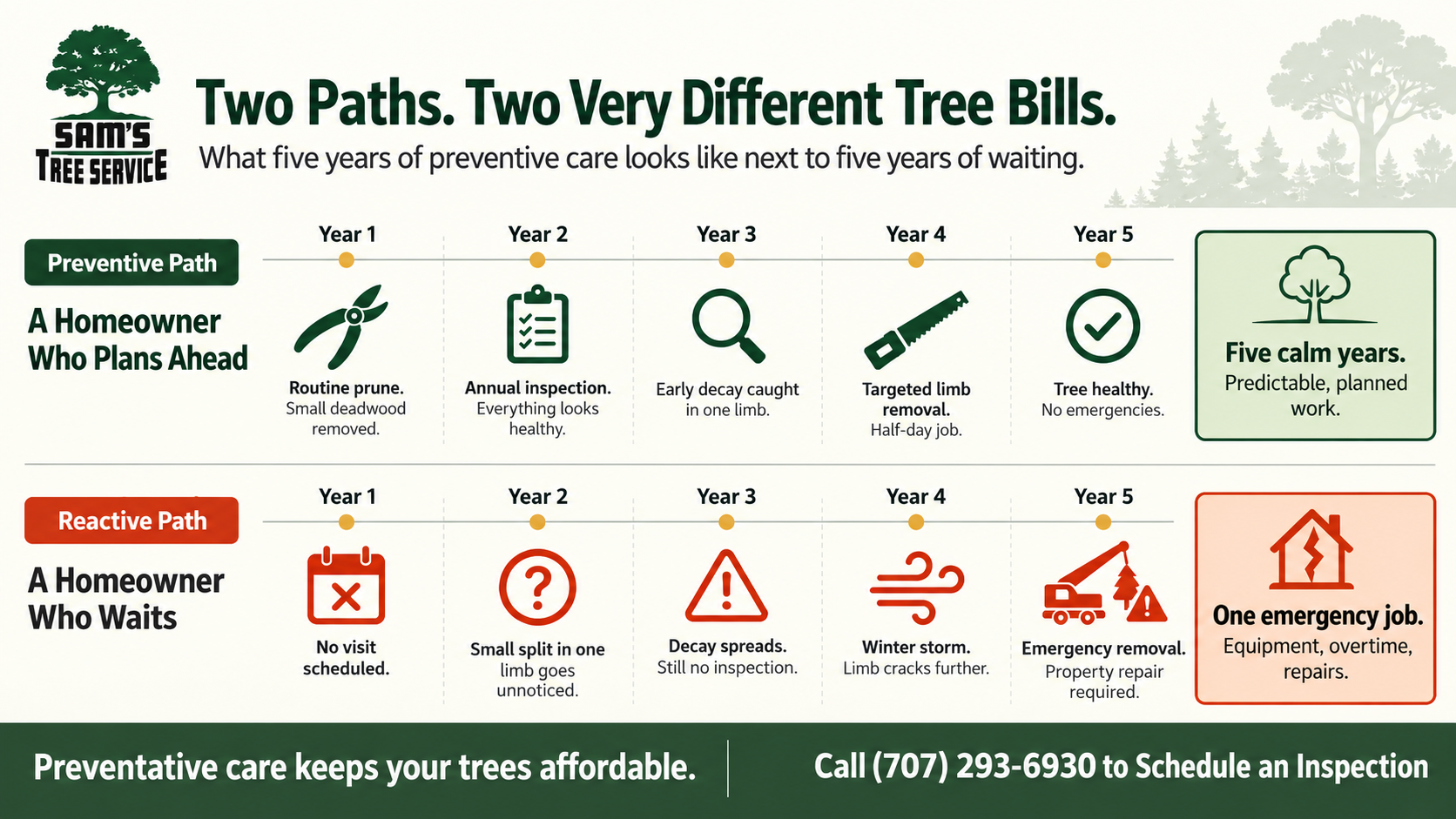
Trees don’t pause while a decision gets delayed. The problem grows at the rate the tree grows, and sometimes faster.
A limb that could have been removed in a half-day visit three winters ago may now sit:
- Over a neighbor’s roofline
- Over a power line
- Over a driveway that a bucket truck can’t easily reach
The cost drivers that climb while you wait:
- The limb or tree gets larger, so the cut gets harder.
- Access gets more complicated, so equipment gets bigger.
- Risk to nearby property increases, so insurance and liability costs do too.
- Power line proximity can push the job into a specialized category.
By the time an urgent call goes out, the pricing conversation has moved on without you.
The Right Credentials Protect the Tree and the Property
Preventive care only works when the right people are involved. The person inspecting the tree has to know what to look for. The crew doing the work has to know how to protect the tree, the property, and themselves.
That’s where credentials carry weight, from the first walkaround to the last cleanup:
- A qualified arborist reads structural cues, pest signs, and compartmentalization patterns that tell the real story of a tree’s health.
- A Cal OSHA certified crew approaches power line proximity with the training the state requires for that work.
- A fully licensed, insured, and bonded company puts the responsibility for a mistake in the right place, which is a very different conversation than a handshake deal with a crew that showed up in an unmarked truck.
Preventive care done by the wrong hands can create problems that weren’t there before:
- Topping cuts
- Bad reductions
- Decay introduced through improper wounds
Sam’s Tree Service, led by Sam Senior’s 30 years in the industry and a father-son team with power line experience, approaches routine work with the same care as the complex jobs. One Google reviewer, Richie L., put it in three words that fit the standard: “Sam is honest, caring, and does a great job.”
Why Routine Visits Are Worth It, Even on a Healthy Tree
Preventive care can feel like paying for nothing. The tree looked fine before the visit and looks fine after. For some homeowners, that’s a hard sell.
The visits that feel least necessary are usually the ones that keep the next five years problem-free.
An unproblematic tree year is a cheap tree year.
Homeowners in Petaluma, Penngrove, and the surrounding Sonoma County neighborhoods who have been on a routine schedule for a decade tend to be the same homeowners who have never needed an emergency call.
A Simple Routine for Petaluma Homeowners
A few practical routines for your property:
- Schedule an inspection every one to three years, sooner for older trees or trees near structures.
- Get on a pruning cycle appropriate for the species. Many Petaluma oaks, maples, and fruit trees do best on a two to three year interval.
- Address small issues when they are found, before they move up a size category.
- Insist on credentials before anyone climbs or sets a saw to your tree.
Affordable tree service in Petaluma means keeping the number small by making sure the work stays routine.
Book an Inspection Before It Becomes an Emergency
An inspection is a straightforward conversation about your trees, your property, and the kinds of bills you would rather never see. For most Petaluma homeowners, it is the most useful call they will make all year.
Sam’s Tree Service serves Petaluma, Santa Rosa, and the surrounding Sonoma County area, and the team speaks both English and Spanish. Contact us online or call (707) 293-6930 for a free estimate today.
Frequently Asked Questions

Owner / Operator, Sam’s Tree Service
Sam Garcia, owner of Sam’s Tree Service, founded his company in 2019. However, the roots of the business go much further back to Sam Senior.
With over 30 years in the tree business, Sam Senior was employed with a large well-known tree company where he gained deep experience working with a power line contractor.
Today, Sam’s Tree Service is a father-son business with full family involvement that combines family values and local commitment with friendly customer service.
With a qualified arborist to oversee the work, customers count on Sam’s for broad expertise with trees, from trimming and pruning to removal, emergency tree services and more. In addition, both Sam Senior and Junior have power line experience, which is essential for any tree work that is in or immediately adjacent to power lines.